


"BlueSyntax" – BlueLane’s Software Development Standard
that ensures every system is controllable, scalable, and delivers long-term business value
One of the most overlooked challenges in organizations is the lack of standardized code
enabling fast development, but making maintenance difficult, limiting scalability, and increasing the risk of system failure as it grows
That’s why BlueLane developed BlueSyntax
built on the concept of “Experience from Real-life Use Case (Your Problem → Our Solution)”
to ensure software is not just functional
but a scalable digital asset that drives real business growth
"BlueSyntax Code Comparison (Before vs After)"
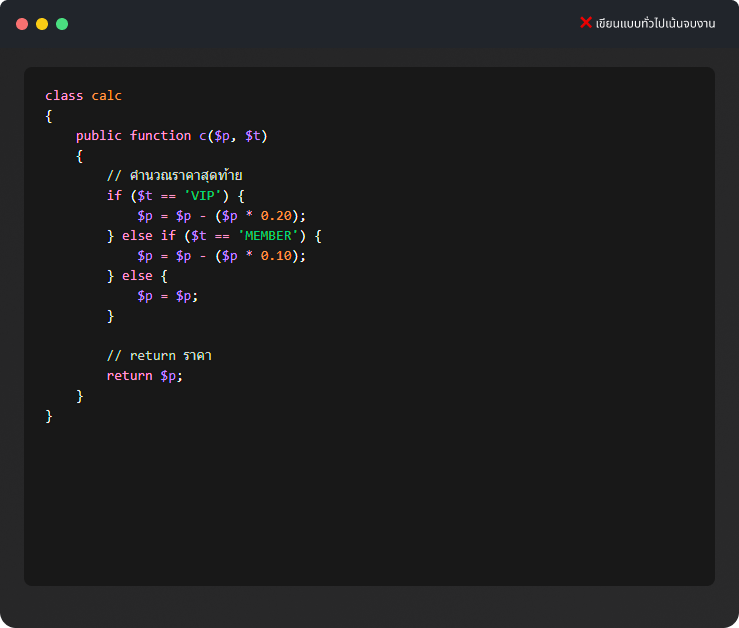
1. Lack of Meaningful Naming (Meaningful Names  )
)
- Variables and functions such as calc, c, $p, and $t fail to clearly convey their purpose
- forcing readers to “guess” what the code does instead of “understanding it instantly”
2. Multiple Responsibilities in a Single Function (SRP ❌)
- A single function handles both “discount logic” and “price calculation”
- As a result, any change in logic requires modifying multiple parts at once, increasing the risk of errors
3. Code Duplication (DRY ❌)
- The calculation formula $p – ($p * …) is repeated multiple times
- Any change in conditions requires updates in multiple places, increasing the risk of bugs and making the code harder to maintain
4. Low-Value Comments ❌
// คำนวณราคาสุดท้าย
// return ราคา
- Comments only describe what the code already shows
- without explaining the “reason” or “context” behind the implementation
5. Poor Readability and Limited Scalability (KISS ❌)
- Excessive use of chained if-else statements creates unnecessary complexity
- As new conditions are added, the code becomes longer and increasingly difficult to manage
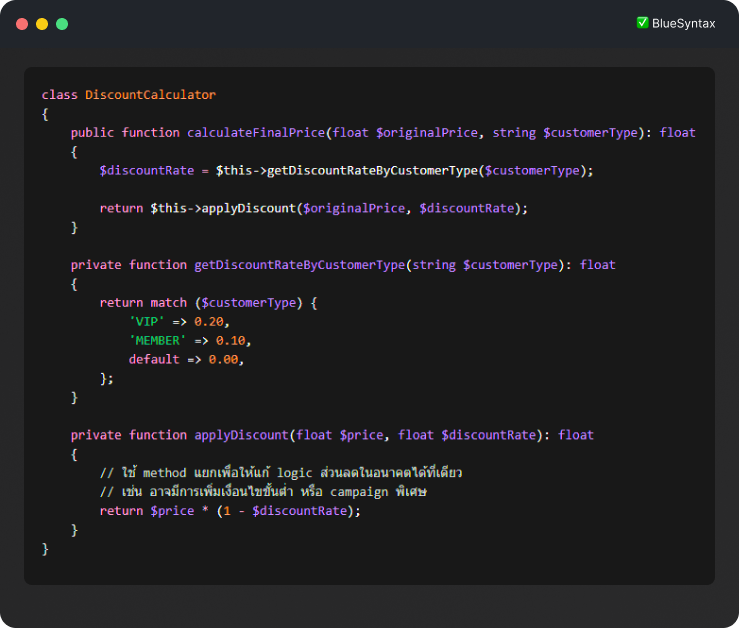
1. Meaningful Naming (Meaningful Names ✅)
- Names like calculateFinalPrice, getDiscountRateByCustomerType, and applyDiscount clearly convey their purpose, allowing readers to instantly understand the code without interpretation
2. Single Responsibility Principle ✅
- Each method is responsible for a single task
getDiscountRateByCustomerType→ กำหนดส่วนลดapplyDiscount→ คำนวณราคา
- This makes the code easier to read and allows targeted modifications without affecting other parts
3. Reduced Code Duplication (DRY ✅)
- The discount calculation logic is centralized in a single place within applyDiscount
- Any changes can be made instantly without affecting other parts of the system
4. Simple and Clean Structure (KISS ✅)
- Using match instead of if-else makes the code shorter, cleaner, and easier to read
- Reduces unnecessary complexity
5. Meaningful Comments (Meaningful Comments ✅)
- Comments are used to explain the “design rationale” not just what the code does, but why it was designed that way for future needs
6. Future-Ready Scalability (Scalable Design ✅)
- New customer types or discount conditions can be added easily without modifying the core system logic
“Results”
- Reduce hidden costs from system fixes
- Accelerate development speed
- Maintain system stability as teams scale
- Enable true business scalability
This is software that doesn’t need to be rebuilt as your business grows
BlueSyntax turns code into scalable, high-performance systems that generate long-term business value
📩 Contact us for expert consultation on scalable software solutions for your business